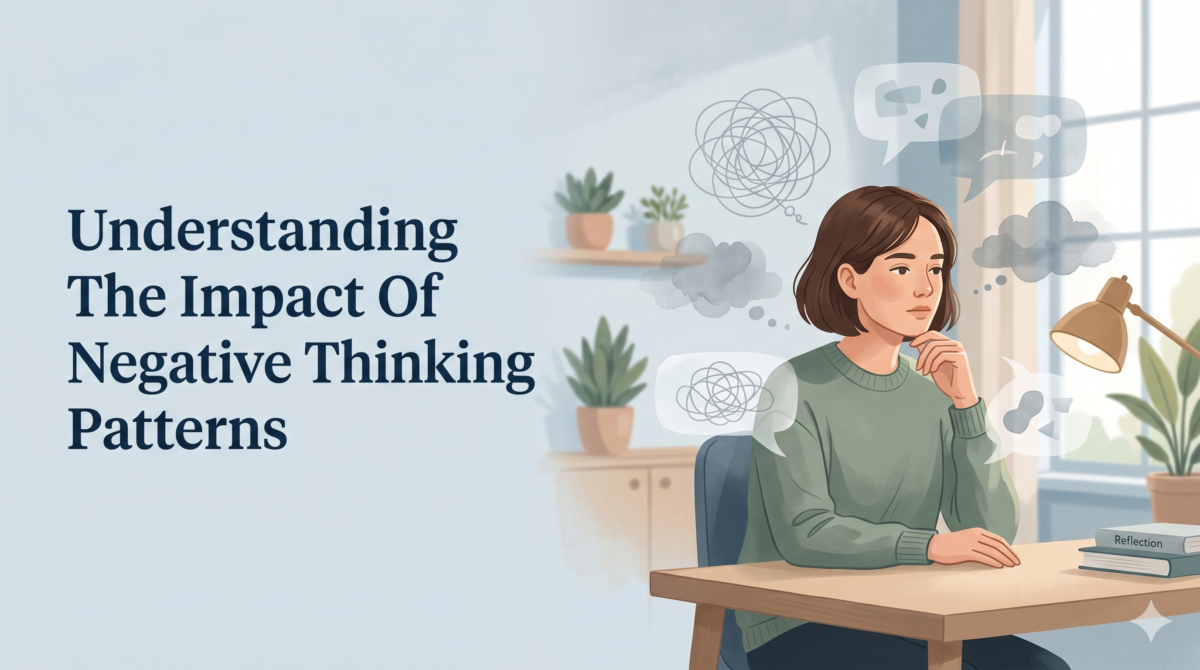
Have you ever looked back at an old conversation in your head to realize that you had made a mistake? Have you ever made a small mistake and blown it out of proportion? Well, it’s not real life; it is just the invasion of negative thinking patterns into your brain. Thinking patterns such as these happen often in many cases; they happen mostly in students and young employees, and soon, they will start affecting your whole outlook, thoughts, and everything around you. So now, let us find out what these kinds of thinking patterns consist of and how we can deal with them.
Negative thinking patterns are thoughts that automatically interpret a situation with a sense of fear, doubt, or criticism towards yourself. Such patterns may appear entirely realistic at the time – sometimes even exaggerated or untrue. Such patterns are strongly associated with cognitive distortions, which refer to mental processes that cause us to misinterpret the situation.
“If I don’t do this right, then I am a failure.”
“I messed up with this one thing; now it is all going to fall apart.”
“This one mistake will cause me to fail forever.”
“They haven’t replied…they must be thinking I’m a failure.”
Taking personal responsibility for things out of your control.
Though each example may not appear significant on its own, when it happens repeatedly, then it becomes your reality.
One’s thoughts affect their emotional state and subsequently their behavior.
The greater the tendency to think negatively, the greater the body’s readiness to act on it.
Everything feels like it carries anxiety as the brain anticipates any problem that may occur during such events.
Thinking negatively about themselves by asking questions such as;
“What do I have to do before I’m considered good enough?”
“I can never measure up.”
These thoughts will become true over time.
Frequent thoughts of failure, self-hatred, and hopelessness will make life burdensome.
You will feel demotivated, stuck, and unable to engage in any activity.
Thinking excessively will drain you mentally.
You will analyze the conversation, consider possible bad results, and review situations that never happened.
But still, you will feel entirely exhausted.
The negative thoughts may create misunderstandings about others:
Such misunderstandings might make you distance yourself from your dear ones.
If you feel like you will fail, then you might give up trying.
You steer clear of chances, dangers, or challenges — not because you’re unable, but because you convince yourself that you shouldn’t.
This is not something that arises out of thin air — there’s almost always an underlying cause.
Stress means your brain is always on guard and focused on identifying problems.
Rejection, criticism, and failure are experiences that condition your mind to expect the worst to happen.
When comparing yourself to others continuously, for instance, through social media, you may become unsure of yourself.
Individuals tend to consider their thoughts as truth, whereas, in actuality, they are mere thought processes.
Should this ring a bell, then your thought patterns might be impacting your mental well-being beyond what you think.
You do not have to try to “think positive.”
You simply have to think more rationally and compassionately.
Take time to reflect on:
“What thought am I currently holding?”
Recognition is the first step towards change.
Is this catastrophizing? Overthinking? Black-and-white thinking?
Naming the thought creates some separation from it.
Consider the following:
Example:
“I always screw everything up.” → “I have managed challenging situations in the past.”
Instead of:
“I can’t do this.”
Use:
“I don’t feel capable of doing this at the moment, but I can figure this out gradually.”
Thinking too much happens inside your head. Break this cycle with some practical actions.
Send the message. Ask the question. Make the first move.
Small habits that can have a great effect:
It will prevent cognitive overload.
Should the described thoughts influence your everyday functioning, work performance, or personal life, professional advice can be very useful.
Here at Ahana, people often face such problems. Help is always accessible.
Should you encounter someone who feels stuck, don’t say “stay positive”.
Instead:
It is surprising how helpful understanding alone can be.
Does overthinking lead to depression and anxiety?
Yes, overthinking leads to stress and anxiety and sometimes even depression, depending on the functioning of the mind.
Why do I always think negative despite there being no problem at all?
It is because of the experience one has had in his/her lifetime. The mind has gotten used to thinking about the things that never existed.
What is the way to stop negative thinking?
You need to stop, recognize the thought, challenge its validity, and concentrate on taking an immediate step.
When do I need help from a professional?
You should seek professional help when you are having problems with sleep, work, relationships, or leading a normal life.
Negativity could influence your mental state, confidence, and even personal connections indirectly.
However, they don’t have to be permanent.
The moment you decide to question your thoughts instead of taking them at face value, changes will start happening.
There are some realities which don’t exist.
Your anxieties don’t have to define reality.
Nor does it have to be an individual effort.


 NABH Certified